The relief that makes things worse
Avoidance feels like the smart move. You were anxious, you removed the source of anxiety, and the anxiety went away. Problem solved. Except your brain just learned something: that situation was dangerous, and escaping it was the right call.
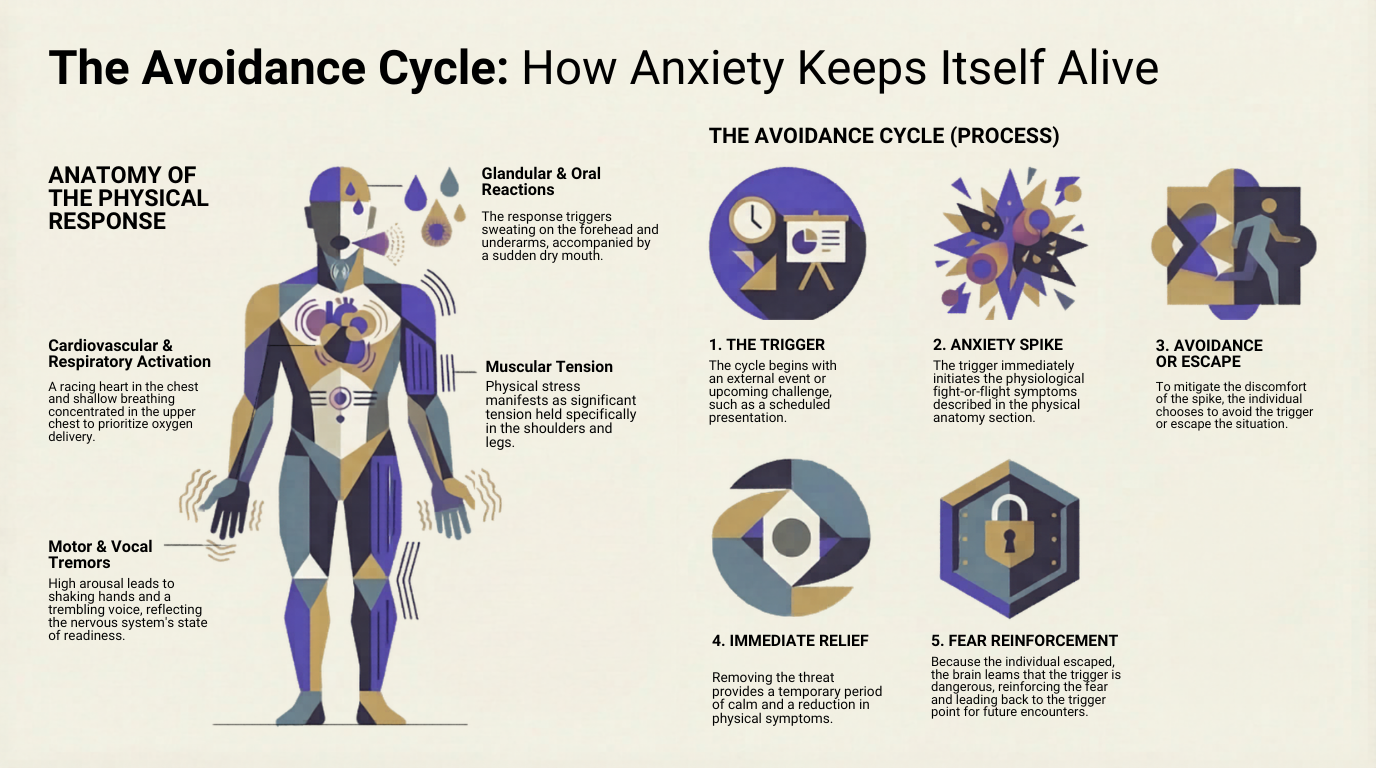
This is how anxiety disorders develop and maintain themselves. In psychology, it's called negative reinforcement — the behaviour (avoiding) is strengthened because it removes something unpleasant (the anxiety). Each time you avoid, the association gets stronger. The speaking situation becomes more threatening in your mind, not less.
The cycle
1. Trigger: A speaking opportunity appears — a meeting, a presentation, an introduction.
2. Anxiety spike: Your body responds with fear. Heart rate up, stomach tight, thoughts racing. (If you've ever wondered why your body shakes before presentations, this is the mechanism.)
3. Avoidance: You decline, delegate, stay quiet, call in sick, sit in the back row.
4. Relief: The anxiety drops immediately. Your brain logs this as a successful escape from danger.
5. Reinforcement: Next time the trigger appears, the anxiety is slightly higher — because your brain now has "evidence" that this situation requires escape.
Over months and years, this cycle shrinks your world. It starts with avoiding big presentations. Then it's meetings. Then it's speaking up in casual conversations. Then it's job interviews. Then it's opportunities you don't even consider applying for because they might involve speaking.
The avoidance doesn't just maintain the anxiety. It grows it.
What avoidance actually costs
The immediate cost is obvious: you didn't give the presentation. But the compounding costs are harder to see because they're things that didn't happen.
The promotion you didn't apply for because the role involves presenting. The idea you didn't share in the meeting that could have changed the project's direction. The connection you didn't make at the networking event because you left early. The raise you didn't negotiate because the conversation felt too exposing.
Research consistently shows that public speaking anxiety correlates with lower career advancement, lower salaries, and reduced job satisfaction — not because anxious people are less capable, but because they systematically remove themselves from situations where visibility matters.
Why willpower isn't enough
Knowing that avoidance is counterproductive doesn't automatically make you stop doing it. That's because avoidance isn't a rational decision — it's a learned automatic response. By the time you're consciously thinking about whether to accept the presentation slot, your amygdala has already triggered the alarm and your body is already steering you toward the exit.
This is why "just do it" advice is frustrating and mostly useless. You can't override a fear response with determination alone, any more than you can will yourself to stop flinching when something flies at your face.
What works instead: graduated exposure
The evidence-based treatment for avoidance is exposure therapy — deliberately, gradually, and repeatedly facing the feared situation in a controlled way. The key word is graduated. You don't jump from avoiding all speaking to giving a keynote. You build a ladder.
At the bottom of the ladder: speaking aloud alone. Recording yourself talking about something you know well. Listening back. This sounds trivially easy, but for someone deep in the avoidance cycle, even hearing their own recorded voice can trigger anxiety.
Next rungs: speaking to one trusted person. Then a small group. Then a slightly larger group. Then a more formal setting. Each rung is held until the anxiety naturally decreases — a process called habituation. Your brain learns, through direct experience, that this rung is survivable. Then you move up.
The critical principle is that you stay in the situation long enough for the anxiety to peak and then subside on its own. If you leave while anxiety is still high, you've just done another avoidance. If you stay, your brain gets to experience the full arc: anxiety rises, peaks, and falls — all without the catastrophe it predicted.
Breaking the cycle in practice
You don't need to wait for a real speaking opportunity to start exposure work. In fact, it's better if you don't — real situations have too many variables and too much at stake for early practice.
Structured practice environments — where you can control the difficulty, repeat the exposure, and build gradually — are where the real progress happens. Think of it like rehabilitation after an injury: you don't start by running a marathon. You start with controlled exercises that rebuild strength and confidence incrementally.
Start at the bottom of the ladder
Nervless is a structured programme that takes you from understanding the fear through body management to gradual exposure — one session at a time, with AI feedback on your voice. No audience. No judgement. Just practice.
Start free at nervless.appThe uncomfortable truth
There is no way to overcome speaking anxiety without feeling some anxiety along the way. Avoidance is comfortable in the short term and devastating in the long term. Exposure is uncomfortable in the short term and transformative in the long term.
The good news is that it doesn't take as long as you'd think. Most people experience a meaningful reduction in anxiety within 4–8 weeks of consistent, graduated practice. For a more detailed breakdown, see how long it takes to overcome public speaking anxiety. The fear doesn't disappear entirely — but it stops running your decisions.